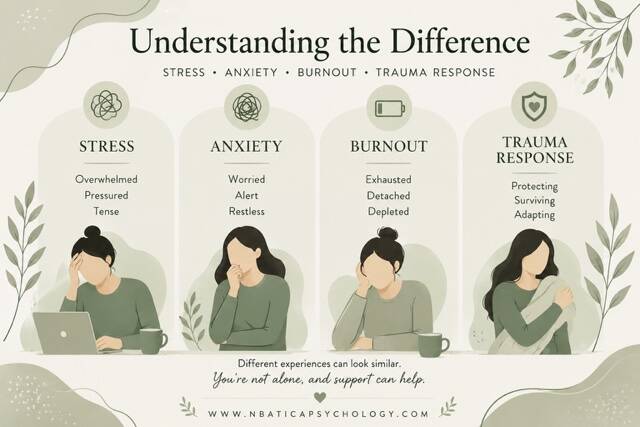
Stress, Anxiety, Burnout or Trauma Response? Understanding the Difference
Many women come to therapy saying some version of:
- “I’m exhausted.”
- “I can’t switch off.”
- “I feel overwhelmed all the time.”
- “I don’t know what’s wrong with me.”
The challenge is that stress, anxiety, burnout, and trauma responses can feel very similar. They can all affect your mood, sleep, relationships, concentration, and overall wellbeing.
Understanding the difference can help you identify what support you need and remind you that there is a reason you feel the way you do.
What Is Stress?
Stress is your body’s natural response to pressure or challenge.
In small amounts, stress can be helpful. It can motivate us to meet deadlines, solve problems, and manage important responsibilities. However, when demands outweigh our resources for too long, stress can start affecting both physical and mental health.
Common Signs of Stress
- Feeling overwhelmed
- Racing thoughts
- Irritability
- Muscle tension
- Difficulty sleeping
- Feeling emotionally reactive
- Headaches or fatigue
Stress is usually linked to something happening in the present, such as work pressures, parenting responsibilities, financial concerns, relationship difficulties, or caring for family members. Stress often sounds like, “I have too much on my plate right now.”
Helpful Strategies for Managing Stress
- Identify what is within your control and what is not.
- Break large tasks into smaller, manageable steps.
- Schedule regular recovery time, even if it is only 10–15 minutes.
- Reduce unnecessary commitments where possible.
What Is Anxiety?
While stress is often linked to current pressures, anxiety tends to focus on future possibilities. Anxiety can make us anticipate problems, worry excessively, and remain alert even when there is no immediate danger. Many women with anxiety appear highly capable on the outside while privately carrying significant worry and self-pressure.
Common Signs of Anxiety
- Persistent worry
- Feeling on edge
- Difficulty relaxing
- Restlessness
- Panic attacks
- Difficulty concentrating
- Physical symptoms such as a racing heart or upset stomach
Sometimes anxiety can feel like having a smoke alarm that is a little too sensitive that it activates even when there is no real fire. Anxiety often sounds like, “What if something goes wrong?”
Helpful Strategies for Managing Anxiety
- Focus on facts rather than worst-case scenarios.
- Practice slow breathing and grounding techniques.
- Limit excessive reassurance-seeking and doom-scrolling.
- Set aside a specific “worry time” rather than worrying all day.
What Is Burnout?
Burnout is the result of prolonged stress without adequate recovery. Unlike stress, which often feels like “too much,” burnout can feel like “nothing left.” Burnout is particularly common among women balancing multiple roles, including work, parenting, caregiving, household management, and emotional labour.
Common Signs of Burnout
- Emotional exhaustion
- Reduced motivation
- Feeling detached or numb
- Difficulty concentrating
- Increased irritability
- Feeling depleted regardless of rest
Burnout often sounds like, “I know I need a break. I just don’t know when I’m supposed to take one.”
Helpful Strategies for Managing Burnout
- Prioritise rest before productivity.
- Review your responsibilities and identify what can be delegated.
- Reconnect with activities that bring enjoyment rather than achievement.
- Set boundaries around work, caregiving, and availability to others.
What Is a Trauma Response?
Trauma responses develop when our nervous system adapts to difficult, frightening, or overwhelming experiences. Trauma is not only about what happened to you. It is also about how your mind and body learned to respond in order to survive.
Trauma can result from experiences such as:
- Childhood emotional neglect
- Family violence
- Sexual assault
- Bullying
- Medical trauma
- Chronic criticism
- Significant loss or instability
These adaptations may continue long after the original threat has passed.
Common Trauma Response
Fight
- Irritability
- Anger
- Perfectionism
- Defensiveness
Flight
- Overworking
- Constant busyness
- Difficulty resting
- Staying productive at all costs
Freeze
- Feeling stuck
- Procrastination
- Emotional shutdown
- Numbness
Fawn
- People-pleasing
- Difficulty saying no
- Prioritising others’ needs
- Fear of disappointing people
Many women assume these patterns are simply part of their personality when they may actually be protective responses developed over time. Trauma often sounds like, “I don’t feel safe enough to slow down.”
Helpful Strategies for Managing Trauma Responses
- Practice noticing and naming your emotional and physical reactions.
- Develop grounding skills that help bring you back to the present moment.
- Build self-compassion rather than self-criticism.
- Seek trauma-informed support to understand and process underlying experiences.
Why Women Often Experience Anxiety, Stress, Burnout and Trauma Response at Once
Life is rarely neat and simple. A woman may be experiencing workplace stress, anxiety about the future, burnout from caring responsibilities, and trauma responses rooted in earlier life experiences, all at the same time.
For example, someone who learned to prioritise everyone else’s needs as a child may struggle to set boundaries as an adult. Over time, this can contribute to chronic stress, anxiety, and eventually burnout. Understanding these patterns is often the first step toward meaningful change.
A Common Example
Sarah (not her real name) came to therapy believing she had “anxiety.” As we explored her experiences, it became clear that she was managing workplace stress, caring for ageing parents, feeling burnt out from years of putting others first, and carrying people-pleasing patterns that had developed in childhood. There wasn’t one single problem to solve. Instead, therapy helped her understand how these experiences were connected and develop healthier ways of responding to them.
Many women discover that what feels like a personal failing is often a completely understandable response to years of carrying too much.
**Sarah (not her real name) is a fictional example how a woman may experience an overlap of stress, anxiety, burnout and trauma response, and experiences commonly discussed in therapy.**
When Should You Seek Help?
Consider seeking support if:
- Your symptoms have persisted for several weeks or months.
- You feel overwhelmed most days.
- You struggle to switch off or relax.
- Your relationships are being affected.
- You feel emotionally exhausted or disconnected.
- Rest does not seem to help.
- Past experiences continue to affect your present life.
You do not need to wait until things reach crisis point before seeking support. Therapy can help you better understand your experiences, develop effective coping strategies, and create lasting changes that support your wellbeing.
Final Thoughts
Stress, anxiety, burnout, and trauma responses are different experiences, but they often overlap. The goal is not to find the perfect label. The goal is understanding what your mind and body are responding to and recognising when additional support may be helpful. If you have been carrying a heavy emotional load for a long time, you do not have to continue managing it alone.
I work with women experiencing stress, anxiety, burnout, trauma, life transitions, and the invisible emotional labour that often goes unseen. Therapy provides a supportive space to understand your experiences, strengthen coping skills, and move toward a more balanced and fulfilling life.
I offer in-person appointments in Wheelers Hill and Telehealth appointments across Melbourne.