
How Do I Know If I Need to See a Psychologist
If you have been asking this question, something in you is already paying attention.
Many people believe therapy is only for crisis points. In reality, seeing a psychologist is also about support, understanding patterns, and making sense of your experiences at any stage of life.
Signs You May Benefit From Seeing a Psychologist
- You feel anxious, overwhelmed, or emotionally drained most of the time
- You are stuck in repeating patterns in relationships that feel hard to change
- You have experienced trauma, recent or past, that still affects your thoughts, emotions, or body
- You feel disconnected from yourself, others, or your direction in life
- You cope by shutting down, overthinking, or constantly pushing through
- You want deeper self understanding, even if you cannot fully explain why
Sometimes it is not a clear sense that something is wrong. It is a quieter feeling that something is not quite right anymore. Therapy offers space to slow down, reflect, and begin to gently untangle what has been carried, often for a long time.
How to Choose the Right Psychologist for Your Needs
Choosing a psychologist is not only about qualifications. It is about finding someone you feel safe enough to be real with.
Areas of Support
Look for a psychologist who works with your specific concerns such as:
- Trauma and complex trauma
- Anxiety and stress
- Cultural identity and intergenerational experiences
- Relationship and family dynamics
- Life transitions and emotional overwhelm
Therapeutic Approach
Different psychologists use different approaches. Some focus on practical strategies, others on deeper reflection and processing. Many combine both.
Trauma informed therapy may include approaches such as EMDR, somatic work, or integrative talk therapy.
Cultural Understanding
Feeling understood matters. You may prefer a psychologist who understands cultural identity, family systems, and generational patterns.
Practical Considerations
When choosing a psychologist, consider:
- In person or Telehealth sessions availability
- Availability and consistency of sessions
- Fees and long term affordability
The Felt Sense After a Session
After an initial session, notice how you feel
- Did I feel heard
- Did I feel emotionally safe
- Can I imagine building trust here
There does not need to be instant connection, but there does need to be enough safety to begin.
What to Ask a Psychologist in the First Session
Starting therapy can feel unfamiliar. You do not need to prepare perfectly, but a few questions can help you feel grounded.
Experience
- Have you worked with concerns like mine before?
- Do you work with trauma or long term patterns?
Approach
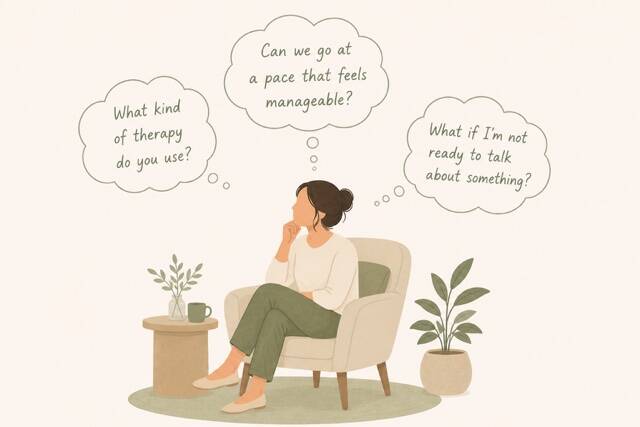
- What kind of therapy do you use?
- How do you usually work with clients?
Process
- What might therapy look like for me?
- How will we know if therapy is helping?
Safety and Pace
- What happens if I am not ready to talk about something?
- Can we go at a pace that feels manageable?
Practical Questions
- How often should I attend sessions?
- What is your cancellation policy?
It is also completely okay not to ask anything. The first session is about beginning, not performing.
When You Are Ready to Start Therapy
Reaching out to a psychologist can feel like a significant step, especially if you have been managing things alone for a long time. You do not need to do everything at once.
You can start with one session. You can take your time. You can move at a pace that feels safe enough for you.
Therapy is not about fixing you. It is about creating space to understand yourself, process experiences, and move forward in a way that feels more aligned.
Therapy Sessions Available
- In person sessions in Wheelers Hill, Melbourne
- Online therapy available across Australia
Next Step